Overture
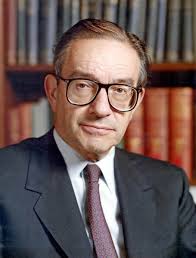
In this essay, I want to pay homage to Alan Greenspan – the man, the myth, and the musician. As a musician myself, I know full well that one can learn much from a career in music: how to be an inspiring and effective leader, how (and when) to take adventurous but calculated risks, or how to transform every uncertainty and irremediable dead-end into an artistic intent, a thing of beauty. I’m positive that before he came into his own in the lofty vestibules of finance and economic policy, Greenspan’s mettle was made in the swanky swing halls of New York City. But how did music and being a musician shape him for his future success as an Economic Titan?
As a boy, I often heard his name on the news on television, and saw him give profound speeches about money and monetary policy – none of which I could comprehend at that time. But the name stuck, and when I reached my early teens and started dabbling more seriously in music, I learnt that Alan Greenspan had once played clarinet and even studied at the Juilliard School - which further piqued my curiosity and fascination for the man. Fast forward thirty-odd years, and for a recent paper on Macroeconomics, my colleagues and I did a thesis on the Nasdaq Bubble (1995-2000) – and, of course, Alan Greenspan was a central figure who presided over the debacle, whose loose monetary policy inflated it, and whose rapidly-hiked interest rates subsequently burst the dot-com bubble. During his speech in which he warned of “irrational exuberance” in the stock market, Greenspan famously asked how to know when market psychology—not fundamentals—has unduly escalated asset values.
Famed Washington Post investigative journalist Bob Woodward coined a name for him – “The Maestro” - and this moniker stuck for the man who chaired the Federal Reserve for nearly two decades. Although the term more naturally befits a conductor, in this case it was not misplaced – as Greenspan judiciously set the tempo of the American economy and deftly steered it with his tenacious vision; just as he did in his youth when he kept time in a swing band, reading clarinet and tenor saxophone parts off a stand.
Granted, the connection between those two careers is not a linear progression: music did not make Greenspan an economist, and the man himself once said leaving music for economics was “the wisest economic decision I ever made”; yet the habits a musician learns—listening, timing, restraint, improvisation within a fixed structure, and the discipline of fitting your phrase to someone else’s—are exactly what defined his leadership style decades later at the Fed.
Exposition
Alan Greenspan was born on March 6, 1926 in New York City. His parents separated early, and he was raised largely by his mother in a household where music was always present—his mother loved singing and dancing, and his grandfather had been a cantor. In his youth, he idolized Benny Goodman, the king of swing, and took up the clarinet in an effort to emulate him.
Greenspan also had another (no less) impressive talent: mastering numbers. By age five, he was reciting baseball batting averages and doing large calculations in his head. A cousin recalled that as a boy he “knew everyone’s batting average in the Major Leagues”. Although seemingly unrelated, both abilities were forms of pattern recognition—the ability to hear or see the structure within a stream of information. I’d go so far as to say that the roots of music and statistics are fundamentally similar: one has to find “the regularity beneath the noise”.
After graduating high school in 1943, Greenspan enrolled at the Juilliard School to study clarinet. Deemed unfit for military service because of a lung condition, he lasted barely a year before dropping out to tour as a professional musician. He joined a swing band, toured with them through the country during the peak of jazz and jitterbug, playing tenor sax, clarinet, and bass clarinet. As luck would have it, among his bandmates were two men who would play a huge part in his future: the jazz giant Stan Getz and Leonard Garment, Richard Nixon’s future White House counsel.
The bandleader Henry Jerome recalled that Greenspan – although not a master-improviser – was “a disciplined, talented section player who also served as the band’s accountant”, and was never much for partying: after every performance, while everyone headed into the green room for tobacco, pot and alcohol, Greenspan would dart out of the venue and into his hotel room where he immersed himself in books about business and finance – and filed his fellow musicians’ tax returns. Sharing the stage with Stan Getz made Greenspan realise that he would never become a great musician: that self-effacing discovery was what made him leave the band after 16 months for New York University, where he enrolled in 1945, earning a BA summa cum laude in 1948 and an MA in 1950. He went on to doctoral study at Columbia under Arthur Burns – himself a future Fed chairman – but left without finishing; NYU would not award him his PhD in Economics until 1977, and then on the strength of his published writings. It was in the early 1950s that Greenspan fell in with the circle of the novelist and philosopher Ayn Rand, whose absolutist faith in free markets and “sound money” left a deep impression on him as he began to adopt a rigidly Manichean view of economics.
Second Subject
He left Columbia in 1953 and, with the bond trader William Townsend, built a lucrative consulting firm, Townsend-Greenspan - which became one of the most respected private economic forecasters in the country – and became renowned for his methodical, logical analysis of the data; after Townsend’s death in 1958 he took over as president and chief owner. His friendship with Leonard Garment, forged on the bandstand of the Henry Jerome Orchestra, was the link that carried Greenspan into Nixon-era Republican politics. Garment recommended Greenspan to Richard Nixon for the chairmanship of the Council of Economic Advisers; Nixon nominated him in 1974 but resigned hours later, so it was under Gerald Ford that he was sworn in, holding the post from 1974 to 1977. Then in 1981–83 he chaired the bipartisan Greenspan Commission, which restructured Social Security to avert a funding crisis. By the time President Reagan nominated him to the Fed in 1987, he was 61 and a data-obsessed pragmatist, subdued intellectual, and a steadfast free-market conservative.
Development: The Maestro
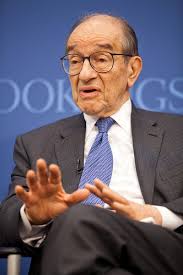
He took office in August 1987 and was immediately battle-tested: in October of that year the Dow Jones fell 22.6% in a single day, threatening the financial and economic system. Together with the president of the New York Fed, Greenspan forcefully persuaded banks and securities firms that it was in their collective interest to keep credit and payments flowing and not to hoard liquidity - making sure the Fed itself was meeting any increased liquidity needs of the financial system. Following that measure, he then issued a single, calm sentence affirming the Fed’s “readiness to serve as a source of liquidity to support the economic and financial system”. The panic subsided, and markets learned that under Greenspan, the Fed would step in to “keep the music playing”. This signature move (and others) soon acquired a name—the “Greenspan put”—which would later also become his indictment.
Perhaps his greatest triumph was the productivity call of the mid-1990s. As the US economy accelerated, conventional models warned of inflation. Greenspan judged that a real productivity surge—driven by information technology—would keep prices contained, and he let the economy run rather than pre-emptively tighten. His gamble paid off: the result was the second-longest expansion in American history, an unbroken decade of growth from 1991 to 2001, characterised by low inflation and falling unemployment—an era christened “the Great Moderation”. Although he also presided over two mild recessions, history will remember him for the exuberant period of growth.
Development Part 2: The Hits & Misses
Greenspan’s repertoire of successes was formidable. His steady hand guided markets through the 1990–91 recession, the 1994–95 Mexican peso crisis (which he helped resolve through a Treasury-led U.S. bailout), the 1997 Asian financial crisis, and the 1998 collapse of the Long-Term Capital Management hedge fund. He consolidated the inflation-fighting gains of his predecessor Paul Volcker, defining price stability as inflation low enough that households “didn’t have to take it into account” in their decisions. He also proved indispensable, as three consecutive presidents—George H.W. Bush, Bill Clinton, and George W. Bush—reappointed him.
However, following the dot-com bust, recession, and the shock of September 11, 2001, he reached for his familiar remedy, lowered the federal funds rate from around 6% to 1%—a level not seen in the United States for forty-five years. That wasn’t the problem. Although the economy recovered, the Fed held rates there for a year too long, and when Greenspan finally hit the brakes in 2004, it was too late: markets did not respond as he had hoped. The cheap money had flowed straight into housing.
His ideology did not help. A lifelong advocate of deregulation, Greenspan “believed financial institutions had a self-interest in not taking risks that would wipe out shareholders” and “natural incentives to behave ethically to preserve the value of their reputations”. As a result, the Fed didn’t raise the alarm on riskier lending practices in which Wall Street used financial alchemy to turn dodgy mortgages into highly rated securities. He dismissed concerns about a housing bubble, insisting prices had never declined nationwide. When the housing market finally did collapse, the subprime mortgage crisis detonated within a year of his departure.
Development Part 3: Climax
The wrecking ball came in October 2008. A defeated Alan Greenspan sat before Congress and confessed. “I have found a flaw,” he said of the free-market worldview that had guided him for forty years. “I don’t know how significant or permanent it is. But I have been very distressed by that fact.” He called the turmoil a “once-in-a-century credit tsunami” that had proven “far broader than I could have envisioned,” and admitted he had erred in assuming “that the self-interests of organizations, specifically banks and others, were such that they were best capable of protecting their own shareholders”. The Wall Street Journal later wrote – and quite on point – that that was the moment when “the music stopped” in 2008, producing the panic that did so much harm to the free-market economy Greenspan had promoted.
Recapitulation
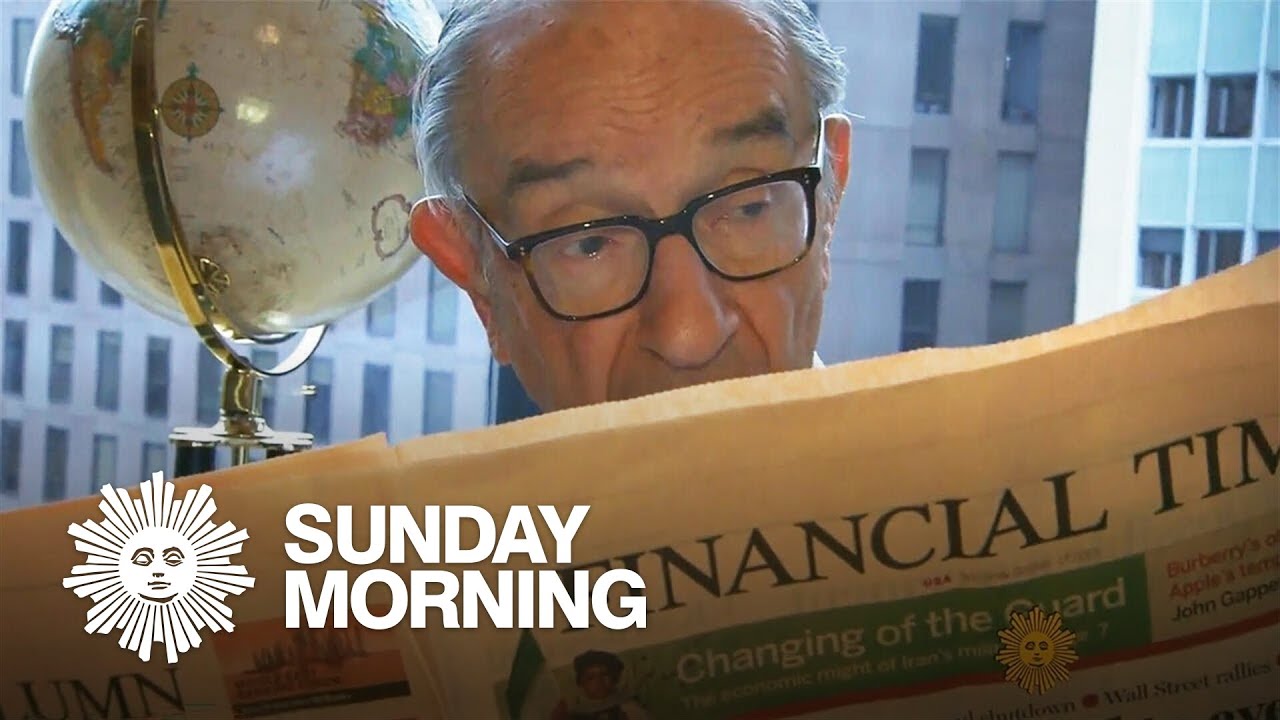
Around the turn of the millennium, politicians praised him as “the greatest central banker in the history of the world”. He was “a cult figure”: “even a furrowed brow would make investors wonder what it meant”. Favourable media coverage “raised his profile to a point that several observers likened him to a rock star”. The rise of financial television—CNBC broadcasting his every word ‘live’—meant that his deliberately inscrutable utterances moved global markets by the billions. Across the world, central bankers and finance ministers took their cue from Washington. It would have been an accurate assessment that one man’s judgment was treated as the closest thing capitalism had to a conductor’s baton.
Coda
The following is my take on Greenspan’s command of Economics as influenced by Music: his entire approach to monetary policy was rhythmic: he studied every data point, and like a good sight-reader was able to adjust rates pre-emptively - “moving policy levers to seize future moves away from price stability,” acting on forecasts and “very good at seeing shifts in future short- to intermediate-term economic developments”. He possessed an extraordinary instinct for listening—both to data and to people - and like every good chamber musician, Greenspan was able to feel the overall pulse and his surrounding thematic/harmonic signals (conversely, a central banker who cannot feel the cycle wouldn’t be able to steady an economy).
Greenspan watched incoming data like a hawk, prized “pure, period-by-period discretion” over rigid rules, and refused to be pinned down in a “doctrinal straitjacket”. That’s what musicians do when interpreting music: they play exactly as the composer had written - observing every tempo and dynamic marking - but still realising that so much has been deliberately left unsaid behind and between the notes. Like a sight-reader, he cherished “option value”—the freedom to react to the next data point rather than commit in advance. Not one to shy away from grandiose musical gestures, he was also known for his habit of obfuscating his true opinion in long, complex sentences with obscure words so as to intentionally mute any strong market response (critics called this “Greenspeak”).
Restraint and the discipline of the section player made him a Fed Chair who kept inflation subdued and refused to chase fads. Like a trained virtuoso, his “Greenspeak,” with its careful, hedged, deliberately muted phrasing, was the speech of a man trained to practice until he couldn’t get it wrong. In addition, his lifelong preference for the aforementioned “option value” and “minimal strategic constraints” brings to mind a jazz musician’s dislike of being locked in a chord chart before being able to hear what other players do.
Ever the accomplished performer, his ornate speeches on the podium were remnants of his performing days, and with ambiguity as a form of control. He understood well, as only a performer can, that what you leave unsaid shapes the room as much as what you say—and he wielded that silence with extraordinary skill. Biographer Sebastian Mallaby described him as “a consummate Washington power-player” – one able to maneuver presidents and cabinet secretaries into making the decisions he thought best, sometimes without them realizing who pulled the strings. That’s a skill only the best conductors possess. In later life he listened most often to the baroque grandeur of Handel and Vivaldi, and still occasionally played the clarinet.
It is fair to conclude that the musician who became a central banker treated the economy less like a machine than an ensemble—something requiring timing, listening, restraint, and the willingness to improvise within a structure. For most of his career that sensibility served him – and the country – exceptionally well. His tragedy, and the world’s, was the limitation of the machine he was entrusted with: a collective of musicians can be trusted at any time to self-correct – even a large symphony orchestra performing a rhythmically-complex work by Stravinsky or Bartók can adjust their ensemble or intonation in a split-second - but not an entire nation’s economy. That is a massive Tyrannosaurus Rex headed either into free-fall, or a cataclysmic collision with unforgiving results.